 DON’T LEAVE MONEY ON THE TABLE, GET YOUR FREE CASE REVIEW TODAY!

Free Payout Estimates for Car Accidents
Car Accident Settlements Calculated by a Local Injury Lawyer

Checking is simple – Get an estimate in 60 seconds or less!
Checking is simple – Get an estimate in 60 seconds or less!


Don’t Let Insurance Companies Low Ball You

Insurance companies are experts at protecting their bottom line – not yours.
After being in a car accident, their goal is to pay out as little as possible. Without legal representation, it’s easy to accept their first offer, only to find yourself stuck paying out of pocket later.
Checking is simple – Get an estimate in 60 seconds or less!
Car accident compensation should account for more than just the basics.
You may be entitled to payment for:

Medical Bills
Current and future treatments, surgeries, therapy, and medications.
Lost Wages
Reimbursement for time
missed at work due to your injuries.
Property Damage
Repair or replacement costs for your vehicle and belongings.
Pain and Suffering
Compensation for the emotional and physical toll the car accident has taken on your life.
Long-Term Impact
Funds for ongoing care, reduced earning potential, or permanent disability.
Average Payouts for Car Accidents
By calculating your estimate with a real local lawyer, you get the peace of mind that you are being paid for what you deserve.
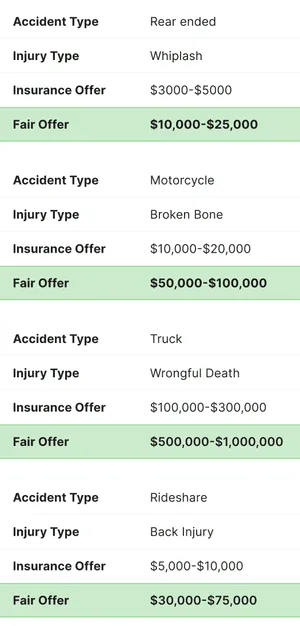
Here are examples of fair car accident settlement values compared to what you would typically receive from insurance.

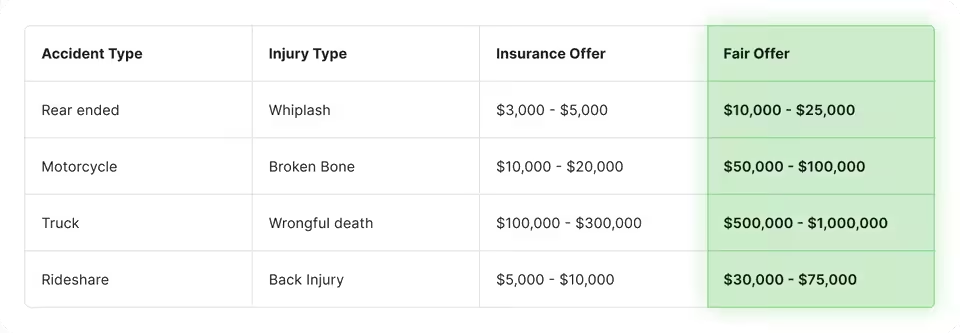
Checking is simple – Get an estimate in 60 seconds or less!
How do car accident estimates work?
1
Answer a Few Quick Questions
Tell us about your auto accident and injuries in just 1 minute.
2
Calculate Your Injury
Estimate your settlement’s payout with help from a real local lawyer.
3
Maximize Your Compensation
Evaluate legal representation to maximize your payment compared to insurance offers.

Get your free case review today and let us help you get what’s rightfully yours.
Don’t Wait! You May Be Leaving Money On The Table!
Frequently Asked Questions
A car accident calculator can estimate pain and suffering as a range, but it ca ot measure it precisely. Most tools use a formula tied to medical costs and recovery time, then adjust based on the seriousness of the injury. Pain and suffering value often depends on consistency. Consistent symptoms, consistent treatment, and clear notes in medical records tend to support higher ranges than “gaps” in care. To make a car accident calculator estimate more realistic, include the length of treatment, any work restrictions, and how the injury affected normal activities like sleep, exercise, driving, or childcare.
A car accident calculator can work well for rear end accidents because many involve similar injuries like whiplash, neck strain, or back pain. The key is entering accurate treatment details. Rear end accident claims often look “minor” from the outside, but the settlement range can change a lot depending on how long symptoms lasted and what your records show. If you were rear ended and symptoms showed up later, document the first day you felt pain and get that timing reflected in medical notes. A car accident calculator uses those details to produce a more realistic estimate.
A car accident calculator is best used as a starting point, not a final number. It estimates a range using inputs like medical bills, time missed from work, and how serious the injury appears based on treatment. What makes a car accident calculator more accurate is real documentation. Add up all treatment costs (ER, urgent care, follow-ups, PT, imaging, prescriptions), estimate lost wages with pay stubs, and note any ongoing symptoms. If you are still treating, your range can change because the full cost and recovery impact is not known yet. The calculator helps you spot whether an offer is in the ballpark or far below common ranges.
A car accident settlement usually starts with the financial losses from the crash, including medical bills, lost wages, and property damage. These costs help show the direct impact of the injury and form the base of many settlement estimates. A common estimate formula looks like this:
Settlement ≈ (Medical Bills × 1.5–5) + Lost Wages + Property Damage
A car accident settlement may increase when treatment lasts longer, injuries are more serious, or medical records clearly document symptoms and recovery. Insurance coverage limits, proof of missed work, and the strength of the documentation can also influence the final car accident settlement range.
Yes, a car accident calculator can help you pressure-test a settlement offer. Start by comparing the offer to your hard costs: medical bills plus lost wages. If an offer barely covers those, it may not reflect the full injury impact. A car accident calculator also helps you think about timing. If you accept money before you understand the full treatment plan, you may end up paying future costs out of pocket. Before accepting anything, make sure you have the full bill list, your treatment plan is clear, and you have notes showing whether symptoms resolved or continued.
A car accident calculator usually combines economic losses and injury impact. Economic losses include medical bills and lost income. Injury impact can include things like how long you treated, how often you went to therapy, and whether you had limitations that affected daily life. A car accident calculator may also account for property damage in some cases, but injury claims are mostly driven by medical records and missed work. The strongest estimates happen when you enter totals from actual bills and include details like diagnosis, length of treatment, and whether symptoms improved or stayed consistent.
To get a helpful result from a car accident calculator, gather your accident report (or incident info), medical visits and dates, itemized bills, and any proof of missed work. Include the start date of symptoms and whether the pain affected sleep, driving, or lifting. A car accident calculator becomes more useful when you track symptoms week by week, because that shows duration, not just a single bad day. If you are still treating, estimate upcoming appointments and likely therapy sessions so the range reflects where your costs may end up.